
What if you could simply talk to your broadcast infrastructure? Instead of navigating through multiple configuration pages or manually correlating status information, we could simply ask:
- “What signal paths are currently active?”
- “Why is there no audio at the receiver?”
- “Connect this sender to that receiver.”
- “Switch to the backup source.”
At this year’s IBC, we at 2wcom presented an experimental approach to connecting AI with broadcast infrastructure using MCP. Our colleague Arne Borsum also explored the concept in his presentation at WSDB 2026 in Erfurt, demonstrating its potential while raising an important question: How much control should we give AI over broadcast systems?
What Is MCP and How Does It Work?
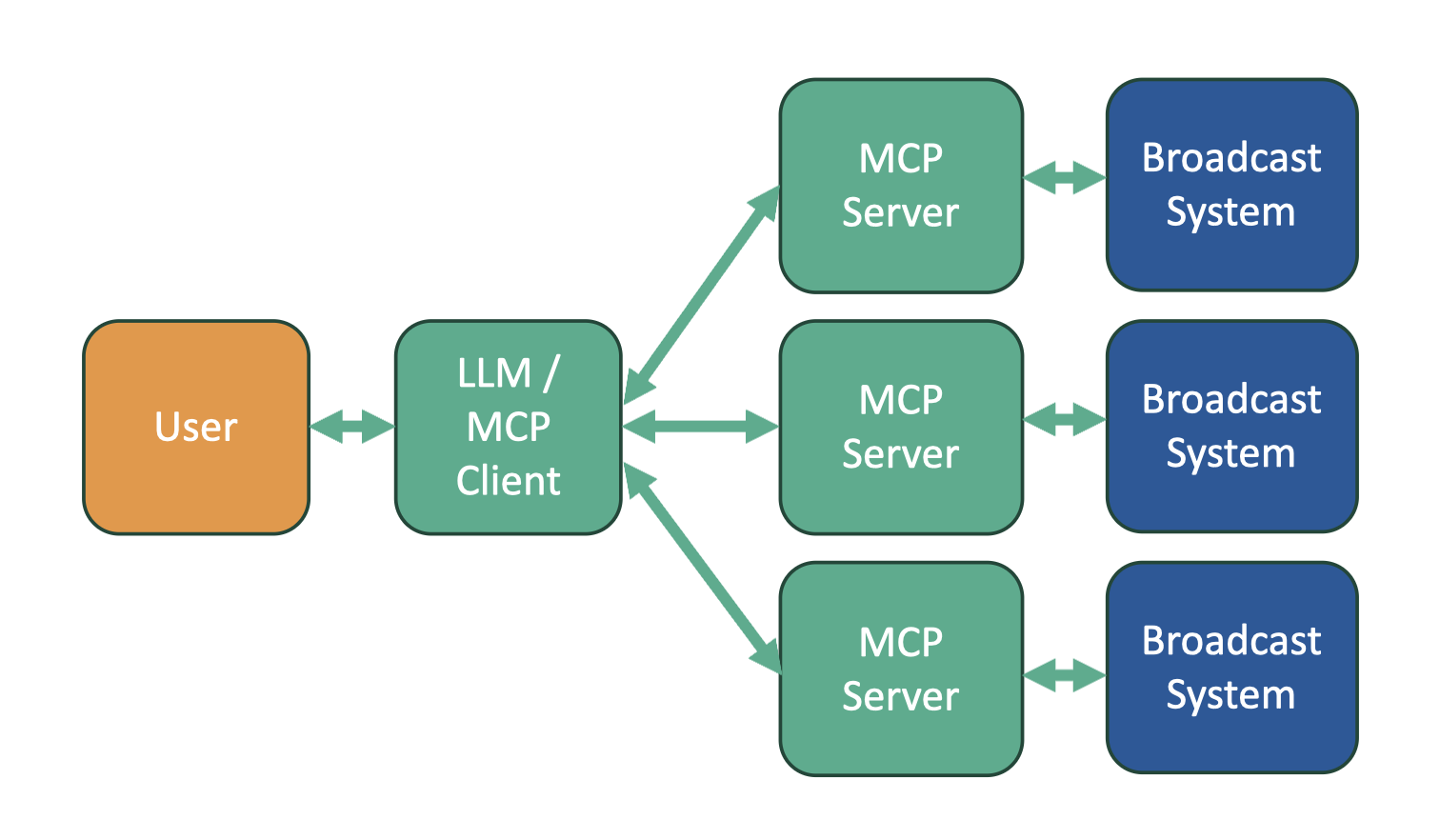
The Model Context Protocol (MCP) is a standardized interface that allows AI systems to access external information and functions. Instead of only generating text, an AI model can interact with connected systems, retrieve information and, if permitted, execute actions.
In a broadcast environment, MCP servers can act as an interface between an AI model and broadcast devices. They translate technical APIs into functions that an AI can understand and use.
For example, instead of working directly with complex API commands, an AI could be provided with a clearly defined function such as switch_to_backup_source(). This makes it possible to interact with broadcast infrastructure using natural language while maintaining control over which actions are available.
From Understanding to Taking Action
To explore these possibilities, we developed demonstrations showing how MCP could be used in broadcast environments.
In one demonstration, an AI model accessed the configuration and status of connected IP codecs. It could identify active audio sources, inspect backup configurations and analyze potential causes of audio problems.
When asked about possible audio distortions, the AI examined available system information and identified a small buffer size as a potential cause. It then suggested adjustments that could improve the situation. After receiving instructions, it was able to apply configuration changes through the connected interface.
Another demonstration combined MCP with NMOS, using the standardized IS-04 and IS-05 interfaces for device discovery and connection management. This approach illustrates how AI could potentially interact with multiple devices in a standardized broadcast infrastructure.
These examples show how MCP could support engineers in monitoring, troubleshooting and configuring complex systems. Instead of navigating multiple interfaces and manually checking individual parameters, users could request information and receive suggestions through a natural-language interface.
How Much Control Should AI Have?
While these possibilities are promising, they also raise important questions about safety and responsibility.
There is a significant difference between allowing an AI to read a device’s status and allowing it to modify configurations or independently control signal paths.
AI interaction with broadcast systems can therefore be considered at different levels of autonomy:
-
Observe: Read system status, configurations and signal paths.
-
Diagnose: Analyze information and identify potential problems.
-
Recommend: Suggest possible solutions.
-
Act with approval: Execute changes after human confirmation.
-
Act autonomously: Perform actions independently.
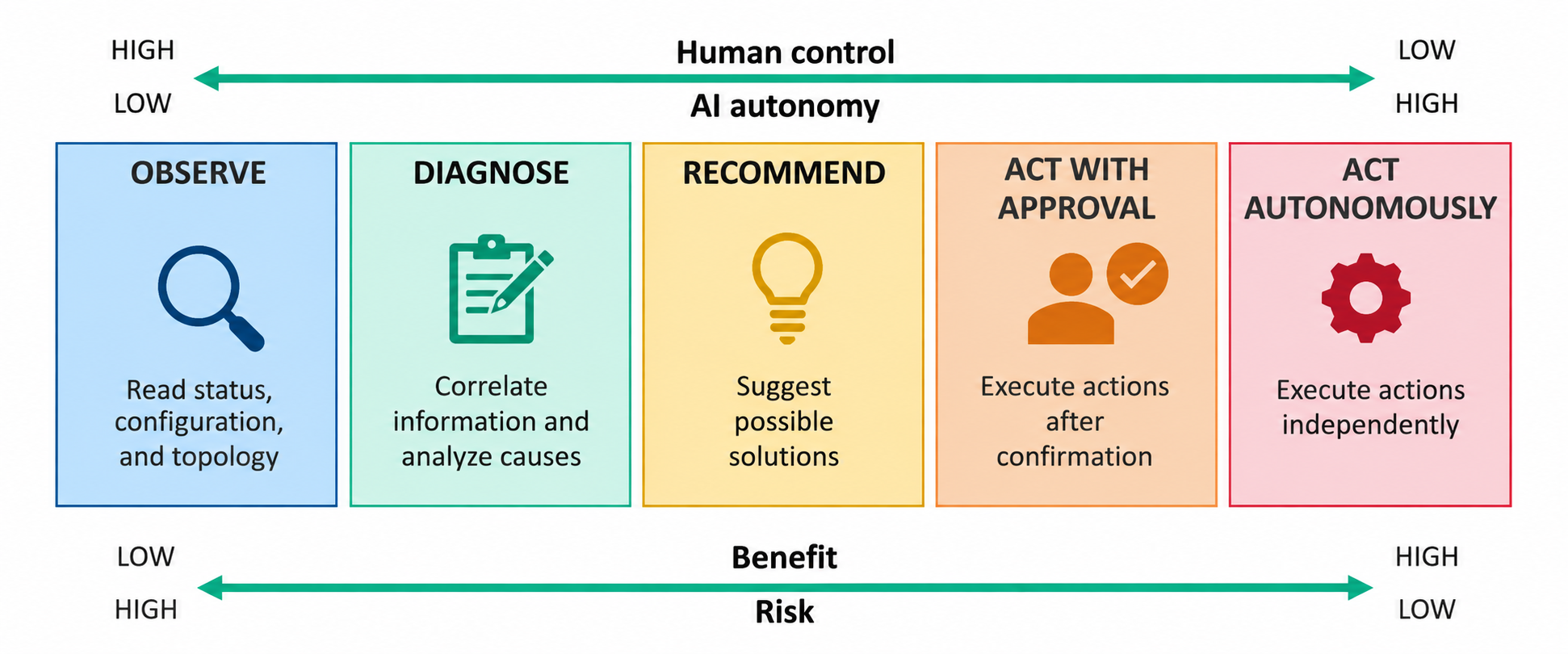
Each level offers different opportunities, but also introduces new risks. Particularly in broadcast environments, where reliability and uninterrupted operation are essential, uncontrolled changes could have serious consequences.
This is why the design of an MCP server matters. Rather than providing unrestricted access to device APIs, it should expose clearly defined functions with appropriate permissions and limitations.
Separating read and write access, validating parameters, requiring confirmation for critical actions and maintaining audit logs are all important considerations.
Ultimately, the goal is not to give AI as much control as possible, but to determine which capabilities can be made available safely and meaningfully.
A Look at What Could Be Possible
MCP-based interaction with broadcast infrastructure is still an experimental and forward-looking concept. Our demonstrations are not intended to present a finished solution, but to explore how AI could change the way broadcast systems are operated and managed.
The potential goes beyond simplifying individual configuration tasks. In the future, AI could help engineers understand complex signal paths, identify problems more quickly and support operational decisions across connected infrastructure.
However, making these capabilities technically possible is only part of the challenge. Equally important is defining where human control remains necessary and how AI-driven actions can be kept transparent, predictable and secure.
At 2wcom, we believe exploring these questions today is an important step toward understanding the possibilities of tomorrow’s broadcast technology.
The question is not only what AI could do with broadcast infrastructure, but what we should allow it to do.