
Sometimes, the biggest changes are the ones listeners never notice.
Arqiva recently completed a major modernisation of the UK DAB Radio Network. Between May 2025 and July 2026, 62 multiplexes and more than 1,000 radio services were migrated to a new Central Coding & Multiplexing System (CCMS), while keeping critical radio services running for millions of listeners across the UK.
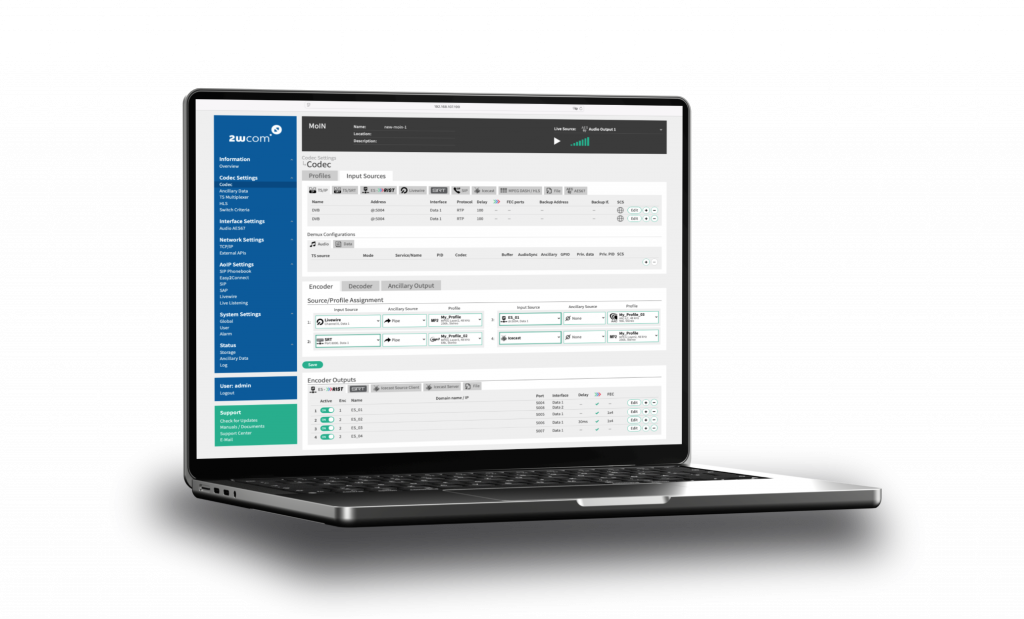
Behind more than 1,000 of these radio services is 2wcom’s MoIN, Multimedia over IP Network Server.
MoIN provides a high density software platform that allows Arqiva to process a large number of radio services on standard off the shelf server hardware. This approach also shows how software architecture can help reduce the infrastructure needed to run a large broadcast network.
More Than 1,000 Radio Services. A Smaller Footprint.
Broadcast networks operate around the clock. Servers and appliances run 24 hours a day, 365 days a year, and every additional piece of hardware means more power, rack space, cooling and maintenance.
That makes processing density important.
MoIN is designed to handle a high number of broadcast services within a software based environment running on standard server infrastructure. Instead of continuously adding dedicated hardware as the number of services grows, processing can be consolidated onto fewer physical machines.
For Arqiva, this high density approach is one part of a much larger infrastructure transformation.
The overall results reported by Arqiva are impressive:
- 62 multiplexes migrated
- More than 1,000 radio services
- 13 UK locations consolidated to 2
- 96% reduction in datacentre capacity
- 87% reduction in energy consumption
All while maintaining the resilience required for a national radio network serving millions of listeners.
Making Better Use of Existing Hardware
The idea behind MoIN is simple: make better use of the computing resources already available.
Running broadcast functionality as high density software on standard servers makes it possible to process many services within a compact IT environment.
Fewer physical servers also mean less electricity, less heat and less energy needed for cooling. They require less rack space and supporting datacentre infrastructure, while reducing the amount of hardware that needs to be operated and maintained.
Put simply:
More services per server means less infrastructure per service.
When you are dealing with more than 1,000 radio services, that can make a real difference.
Broadcast Software on Standard IT Hardware
MoIN does not depend on a dedicated proprietary hardware platform. Instead, it brings professional broadcast processing to standard off the shelf server environments.
This combines the flexibility and scalability of modern IT infrastructure with the reliability and functionality required for professional broadcast operations.
For large network operators such as Arqiva, this creates opportunities to consolidate infrastructure while still meeting the requirements of a mission critical broadcast network.
It also shows that improving efficiency does not always mean adding more specialised hardware. Sometimes, it comes down to using software more effectively.
One Part of a Bigger Transformation
Of course, software alone does not solve the climate challenge. But infrastructure that operates continuously for many years is worth looking at when it comes to resource consumption.
If smarter software can run the same workload on fewer physical systems, it can help reduce energy consumption and the infrastructure required around it.
Arqiva reports an 87% reduction in energy consumption as part of its overall CCMS transformation. Several factors contributed to this result, including datacentre consolidation, automation and infrastructure modernisation.
We are proud that MoIN and its high density software architecture are part of this transformation, processing more than 1,000 radio services while helping enable a significantly smaller infrastructure footprint.
Millions of listeners will never notice what changed behind the scenes.
They will simply turn on the radio and hear their favourite station.
And that is ultimately what good broadcast technology should do: keep the service running reliably while making the infrastructure behind it smarter and more efficient.