
Moderne Broadcast-Netzwerke basieren auf großflächigen Sendeinfrastrukturen. Audio- und MPX-Signale werden über IP-Netzwerke zu mehreren Senderstandorten übertragen und decken dabei häufig große geografische Gebiete ab.
Während diese Struktur Flexibilität und Skalierbarkeit bietet, bringt sie zugleich eine verbreitete technische Herausforderung mit sich:
Im Laufe der Zeit können einzelne Sendeanlagen in ihrer zeitlichen Synchronisation auseinanderdriften.
Die Folge sind hörbare Switching-Artefakte, sobald ein Radioempfänger zwischen Versorgungsbereichen oder Übertragungswegen wechselt.
Typische Beispiele sind:
In einigen Fällen bleibt der Zeitversatz konstant und vorhersehbar. In anderen variiert er. In jedem Fall nimmt der Zuhörer hörbare Diskontinuitäten wahr, etwa Sprünge, Echos oder kurze Unterbrechungen.
Das Problem liegt meist nicht in der Übertragung selbst, sondern in der Art und Weise, wie herkömmliche Decoder die Wiedergabe handhaben.
Die meisten Decoder geben eingehendes Audio unmittelbar nach dem Empfang wieder. Das bedeutet, dass jeder Decoder im Wesentlichen seiner eigenen lokalen Zeitsteuerung folgt, die direkt vom jeweiligen Netzwerkpfad beeinflusst wird.
Schon kleine Abweichungen summieren sich über die Zeit:
clock drift – packet loss – jitter – wechselnde Netzwerkrouten – variierendes Buffer-Verhalten – unterschiedliche IP-Transportwege
Als Folge geraten Senderstandorte, die dasselbe Programm übertragen, nach und nach aus der zeitlichen Synchronisation. IP-Netzwerke sind grundsätzlich nicht-deterministisch. Netzwerklatenz und Routing-Änderungen sind normal und unvermeidbar.
Das eigentliche Problem entsteht, wenn diese Schwankungen direkt die zeitliche Ausgabe des Audios beeinflussen.
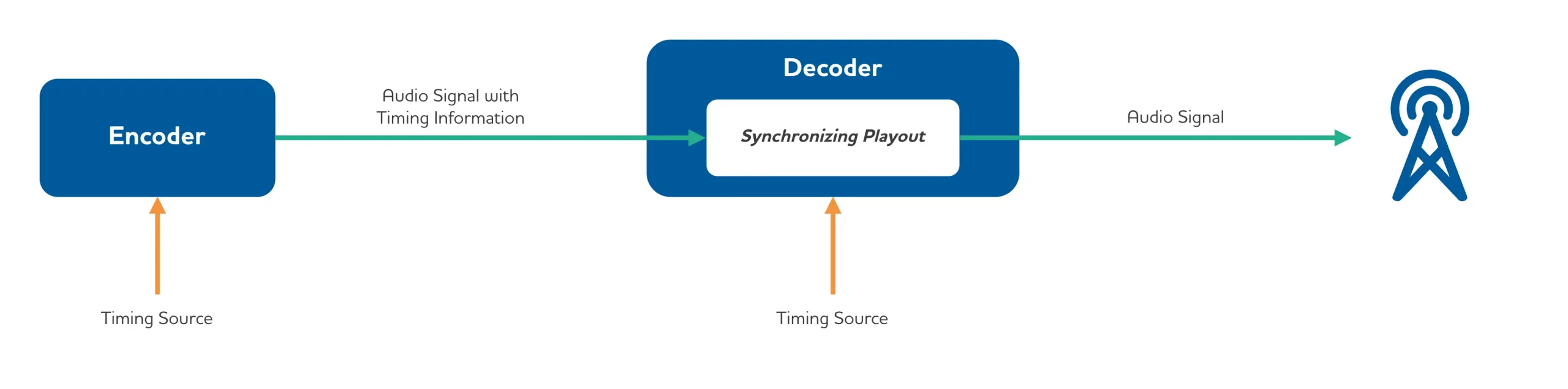
Unsere Synchronisationstechnologie löst dieses Problem, indem sie den Signalempfang von der Signalausgabe entkoppelt.
Statt Audio unmittelbar nach dem Eintreffen wiederzugeben, puffern alle Decoder den eingehenden Stream und warten auf eine definierte globale Ausspielzeit.
Der Synchronisationsprozess funktioniert wie folgt:
Dieser Ansatz macht das Transportnetzwerk aus zeitlicher Sicht effektiv transparent.
Netzwerkschwankungen beeinflussen die Ausgabezeit nicht mehr direkt, sofern die Pakete innerhalb des konfigurierten Verzögerungsfensters ankommen.
In der Praxis bedeutet das:
Selbst wenn das Netzwerk schwankt, bleibt die Timeline unverändert.
Für viele Broadcast-Anwendungen bietet NTP-basierte Synchronisation eine mehr als ausreichende Zeitgenauigkeit.
Unter Verwendung von NTP als Zeitreferenz erreichen Geräte typischerweise eine Synchronisationsgenauigkeit von unter 20 ms und häufig sogar etwa 5 ms, abhängig von der Qualität der NTP-Quelle und den Netzwerkbedingungen.
Für die meisten Broadcast-Anwendungen ist dies ausreichend, um:
Typische Anwendungen sind über größere Entfernungen verteilte FM-Netzwerke, regionale Programmausspielung, Studio-zu-DAB Headend-Zuführungen sowie synchronisierte Kontributions- und Distributionsnetzwerke.
Für einige Anwendungen ist eine deutlich höhere Zeitgenauigkeit erforderlich. Für Single-Frequency-Networks (SFN) und andere phasenkritische Infrastrukturen kann das System 1PPS oder PTP als Zeitreferenz verwenden.
Dies ermöglicht eine Synchronisationsgenauigkeit von unter 1 Mikrosekunde.
Auf diesem Niveau sorgt die Synchronisation nicht mehr nur für die Angleichung der Audiosignale, sondern ermöglicht einen phasengenauen Senderbetrieb, der für SFN-fähige FM-Netzwerke geeignet ist.
Durch die Synchronisation der Ausspielung statt der Abhängigkeit vom Empfangstiming sorgt das System automatisch dafür, dass:
Das Ergebnis ist eine deterministische und vorhersehbare Broadcast-Infrastruktur, selbst in variablen IP-Netzwerken.
Wir schaffen Vorhersagbarkeit.