
Modern broadcast networks rely on distributed transmission infrastructures. Audio and MPX signals are transported over IP networks to multiple transmitter sites, often covering large geographic areas.
While this architecture provides flexibility and scalability, it also introduces a common technical challenge:
Over time, individual transmission sites can drift apart in timing.
The result is audible switching artifacts whenever a radio receiver changes between coverage areas or transmission paths.
Typical examples include:
In some cases, the timing offset remains constant and predictable. In others, it varies dynamically. Either way, the listener experiences audible discontinuities such as jumps, echoes, or brief interruptions.
The issue is usually not the transmission itself, but the way traditional decoders handle playout.
Most decoders play incoming audio immediately after reception. This means that each decoder effectively follows its own local timing, directly influenced by the network path.
Even small variations accumulate over time:
clock drift · packet loss – jitter – changing network routes – varying buffer behaviour – different IP transport paths
As a result, multiple transmitter sites carrying the same program gradually move out of alignment. IP networks are inherently non-deterministic. Network latency and routing changes are normal and unavoidable.
The real problem arises when these variations directly affect the audio output timing.
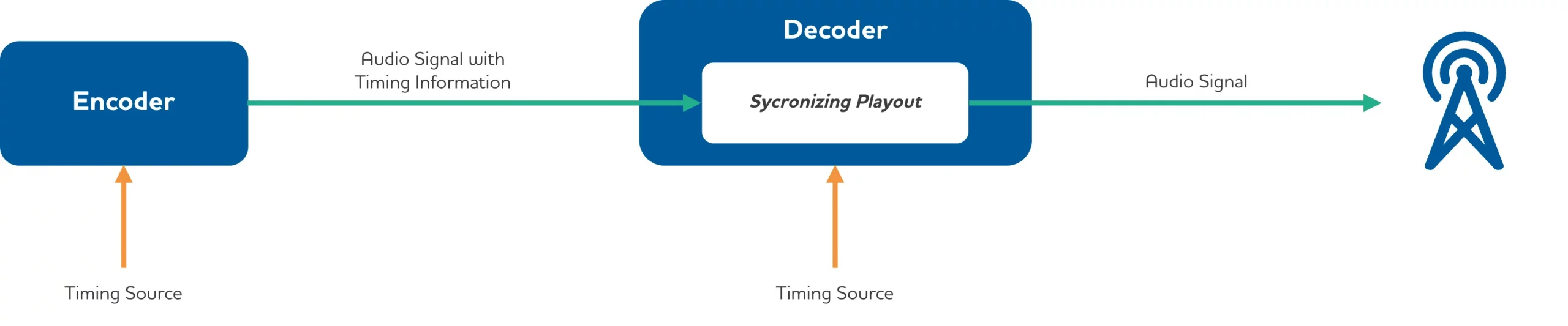
Our synchronization technology solves this by separating signal reception from signal playout.
Instead of playing audio immediately after arrival, all decoders buffer the incoming stream and wait for a defined global playout time.
The synchronization process works as follows:
This approach makes the transport network effectively transparent from a timing perspective.
Network fluctuations no longer directly influence the output timing, provided that packets arrive within the configured delay window.
In practice, this means:
The network may fluctuate. The timeline does not.
For many broadcast applications, NTP-based synchronization provides more than sufficient timing precision.
Using NTP as the timing reference, devices can typically achieve synchronization accuracy better than 20 ms and often around 5 ms, depending on the quality of the NTP source and network conditions.
For most broadcast applications, this is sufficient to:
Typical applications include distributed FM networks, regional program distribution, studio-to-DAB head-end feeds, and synchronized contribution and distribution networks.
Some applications require significantly higher timing precision. For Single Frequency Networks (SFN) and other phase-critical infrastructures, the system can use 1PPS or PTP as a timing reference.
This enables synchronization accuracy below 1 microsecond.
At this level, synchronization no longer only keeps audio aligned, it enables phase-accurate transmitter operation suitable for SFN-capable FM networks.
By synchronizing playout rather than relying on reception timing, the system automatically:
The result is a deterministic and predictable broadcast infrastructure, even on variable IP networks.
We provide predictability.